Your buyers moved to AI search. Does your brand show up?
Most B2B brands are invisible in AI search and don't know it. PureSEM tracks your visibility, builds your presence, and connects it to pipeline.
Your buyers are building shortlists with AI. You don't know if you're on them.
ChatGPT, Perplexity, and Google AI Overviews are recommending vendors to your buyers before they ever visit your website.
AI search surfaces a small set of trusted sources. If your brand isn't in those citations, you're not being rejected. You're never being considered.
None of your standard tools show it. Most teams only notice something is wrong when the pipeline feels different and they can't explain why.
We've seen this before
We've audited over a dozen B2B companies over the past year for AI search visibility.
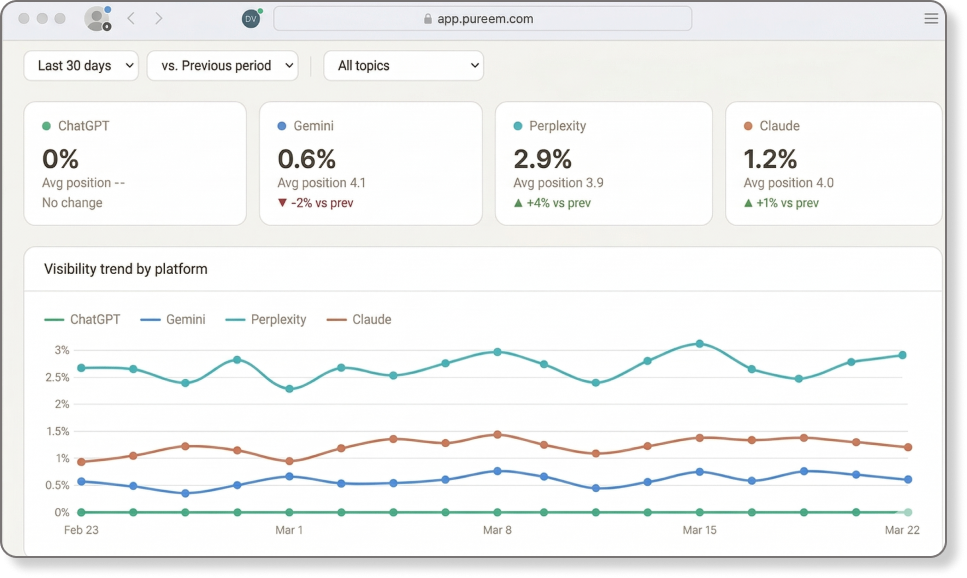
36% of them had visibility scores below 10%. One market leader's brand was mentioned in only 2.9% of our checks. Another had zero presence in ChatGPT. That's not reduced visibility. Zero.
The brands showing up didn't get there by accident. There's a clear path. We know what it looks like.
The questions you need to answer:
-
How does AI Search change our strategy?
Your buyers used to find vendors by searching Google and clicking links. Now they ask AI and get a shortlist.
If your company isn't on that shortlist, you're not even in consideration. The strategy shift is simple to state and hard to execute: you need to be the company AI recommends, not just the company that ranks.
-
Are we showing up in AI search results?
Unless you're ranking on page one or two of Google for the topics and entities that matter to your business, the answer is probably not. Even then, you don't know until you measure it.
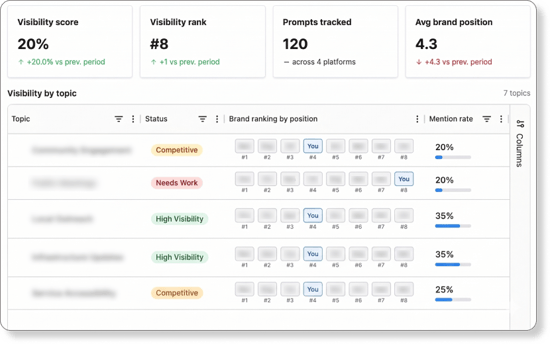
AI-generated answers don't appear in any standard analytics tool. PureSEM monitors your brand's presence across ChatGPT, Perplexity, Claude, and Gemini, and organizes visibility by the topics and buyer personas that matter to your business.
-
Are we getting leads and opportunities from AI?
That's the right question, and most vendors can't answer it. PureSEM connects AI visibility to LLM referrer traffic and CRM pipeline, organized around the same topic structure as your visibility data. When visibility on a topic improves, you can see whether traffic and pipeline from that topic moved with it. -
What are we doing to optimize for AI search?
AI systems favor companies with demonstrated topic authority, strong entity relationships, and content structured for citation.
We audit your visibility, identify the gaps, and build the content and technical architecture to close them, prioritized by pipeline impact, not vanity metrics.
Everything you need to show up, get found, and prove it generated revenue
Visibility, strategy, content, distribution, and attribution all need to work from the same framework. Here's what that looks like.
-
AEO / SEO Strategy & Management
The foundation. AI search engines retrieve from the web in real time. If you're not ranking on page one or two for your most important topics, you're not in the pool. Entity strategy, keyword universe, technical optimization, and content architecture built to rank and to be cited. -
Content Strategy & Development
Topically authoritative, informationally dense content built to answer the specific questions your buyers ask at every stage of evaluation. Original, structured to be cited, and kept current. Recency matters in AI search. -
Digital PR and Content Distribution
High-authority domains are significantly more likely to be cited in AI Overviews. Inbound links evaluated by topical authority, built to improve both traditional ranking and AI citation likelihood. -
Technical On-site Optimization
Structured data, passage optimization, crawlability. The technical layer that lets AI systems extract and cite your content accurately. -
AI Visibility Tracking
Your brand's presence is monitored across ChatGPT, Perplexity, Gemini, and Google AI Overviews. Continuously, automatically.
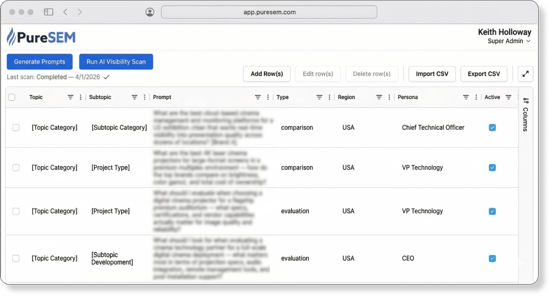
Prompts generated based on your target entities and grounded in your buyer personas.
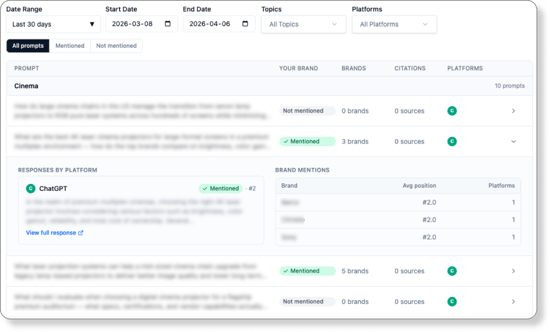
You see where you're cited, where competitors are cited instead, and how visibility shifts over time.
-
Intent Analytics
LLM referrer traffic and direct visits organized by the same topic and entity structure as your AI visibility data.
When visibility on a topic improves, you see whether sessions, leads, and pipeline from that topic respond.
-
Full-Funnel Attribution
Sessions connect to contacts, contacts connect to opportunities, opportunities connect to revenue — in HubSpot or Salesforce. AI search activity shows up in the same pipeline reports your CEO already uses.
Every quarter you're not in AI search, a competitor is
The brands being cited today are building authority that gets harder to displace over time. If your brand isn't in the consideration set when a buyer asks AI to shortlist vendors in your category, that buyer may never reach your website at all. An attribution gap isn't a reporting inconvenience. It's a budget risk, and eventually a pipeline risk.
What changes when the strategy works.
Your CEO asks what inbound generated last quarter. You open the dashboard and show AI search contributing to the pipeline, tracked in HubSpot or Salesforce, not estimated. The conversation changes.
Your company appears in AI-generated answers when buyers research your category. You know it's happening because you're tracking it.
Your content program has clear direction: which topics to build authority on, which gaps are costing you citations right now.
And when AI search behavior shifts, you see it in your data before it shows up as a dip in pipeline.
Ready to build a predictable inbound engine?
We will show you what your inbound opportunity looks like and where the fastest wins are hiding.