

5 min read

The Cannibalization Fear Killing Your Content Strategy (And What the Data Says)

The Cannibalization Fear Killing Your Content Strategy (And What the Data Says)

Your marketing team wants you to build pillar pages. Entity-based content. Hub-and-spoke architecture. Educational guides on the concepts your buyers research before they ever look at your product pages. The argument is solid. The data backs it up.

But you have a specific worry, and it is a reasonable one to have as the person responsible for pipeline. Right now, when a buyer Googles your category, your product page shows up. They click, they see the offer, and some percentage of them convert. If you publish a pillar page on that same topic, Google might decide the educational guide is the better answer for that query. The traffic shows up on a page that wasn't built to convert. Users read, get their answer, and leave. You have replaced a converting page with a non-converting one. You have expanded your content footprint and cut your pipeline.

The good news: that is not how the search engine works.

How Google actually picks which page to show

Google ranks pages by search intent, not by keyword. For any given search query, Google's systems classify what the searcher is trying to do, and then surface pages designed for that job.

When someone searches "enterprise CRM software," they want to buy. Google shows product pages, solution pages, comparison content, vendor lists. When someone searches "what is enterprise CRM," they want to understand. Google shows educational guides, glossary entries, definitional content. Same subject area, different intent, different pages compete for each slot.

Your product page was never going to rank for "what is enterprise CRM." That slot has always belonged to whoever publishes the best educational content on the topic. Right now, if you don't have a pillar page covering it, the slot belongs to a competitor, an industry analyst, or a generic third party like G2 or HubSpot. Building the pillar page captures a slot your product page was never positioned to win, without affecting the slot your product page already holds.

Google's John Mueller confirmed this directly when asked about exactly this scenario in a Google Search Central session. Targeting the same keyword on two pages with genuinely different intents is, in his framing, "kind of reasonable." Google's systems are explicitly designed to surface different page types for different versions of the same query. [1]

The data confirms it

Ahrefs analyzed 9,700 cases of multiple pages from their own site ranking for the same keyword. They manually reviewed a sample of 80 cases. They found exactly one that actually needed consolidation. Their published conclusion: most multi-page ranking is diversification rather than cannibalization, with different pages capturing different facets of the same buyer journey. [2]

For a CMO running the pipeline math, the implication is direct. In nearly every case, your product page keeps ranking for the commercial queries it always ranked for. Your pillar page captures the informational queries you weren't winning anyway. The total pipeline footprint goes up, not down.

The exception worth naming: this only holds if the pillar pages are built with intent discipline. If an educational guide accidentally targets commercial intent (titled "buy enterprise CRM" instead of "what is enterprise CRM," for instance), you have created a real cannibalization risk. That is a content design problem, not a fundamental flaw in the strategy. The fix is rigorous intent alignment per page: distinct URLs, distinct titles, distinct meta descriptions, distinct primary keyword targeting.

Why this matters more in 2026

The pipeline math used to be about which page captures the click on a given Google results page. That math has shifted.

AI Overviews now appear across a meaningful share of Google queries, with particularly heavy coverage on informational searches, the kind of search that happens early in the buyer journey, well before someone is ready to look at a product page. When an AI Overview appears, it cuts the click-through rate to the top-ranked organic result by 58%, per Ahrefs' 300,000-keyword study. [3] Pew Research found that overall click rates on traditional links drop from 15% to 8% when an AI Overview is present. [4]

For these informational queries, the click-through math is largely over. What replaces it is citation visibility: whose content gets pulled into the AI summary?

Seer Interactive's 2026 analysis of 5.47 million queries found that pages cited in AI Overviews receive roughly 120% more clicks per impression than uncited pages on the same query. Per million impressions on informational queries, the breakdown looks like this: no AI Overview present produces about 33,500 clicks; AI Overview present and your brand cited produces about 20,743 clicks; AI Overview present and your brand not cited produces about 9,445 clicks. [5]

PureSEM Blog Hero Image (1)

The content that gets cited is overwhelmingly educational. Pillar pages and definitive guides, not product pages. Without that content layer, your commercial visibility holds (your product page still ranks for commercial intent), but your research-stage visibility disappears. The buyer who is six months out, researching the category, building a vendor shortlist, and asking AI engines for context never encounters your brand. That is the 83% of the buyer journey Gartner says happens before sales gets a hand-raise. [6]

The question to ask

The cannibalization fear, stated correctly, is this: "Will Google replace my high-converting product page with a low-converting pillar page when buyers search?"

The answer is no, as long as the two pages target different intents. Google's ranking systems are explicitly designed for this. Multi-page ranking on related topics is the norm, not the exception. The pillar page captures search traffic your product page was never going to capture, brings those buyers into your content ecosystem, and brings them back when they are ready to buy.

Get the execution right. Ask the right questions of whoever is proposing the strategy:

  • Are the pillar pages targeted at informational intent, not commercial? (Title, meta, H1, and primary keyword should all signal this.)
  • Are URL slugs, page titles, and meta descriptions distinct from existing product pages?
  • Is there a clear retargeting path from pillar page back to commercial pages for buyers who are ready?

If yes, the pillar pages are doing what they were designed to do: extending your pipeline coverage into the research stage of the buyer journey. The product pages keep doing their job. The pillar pages do a job your product pages were never built to do.

What's the solution?

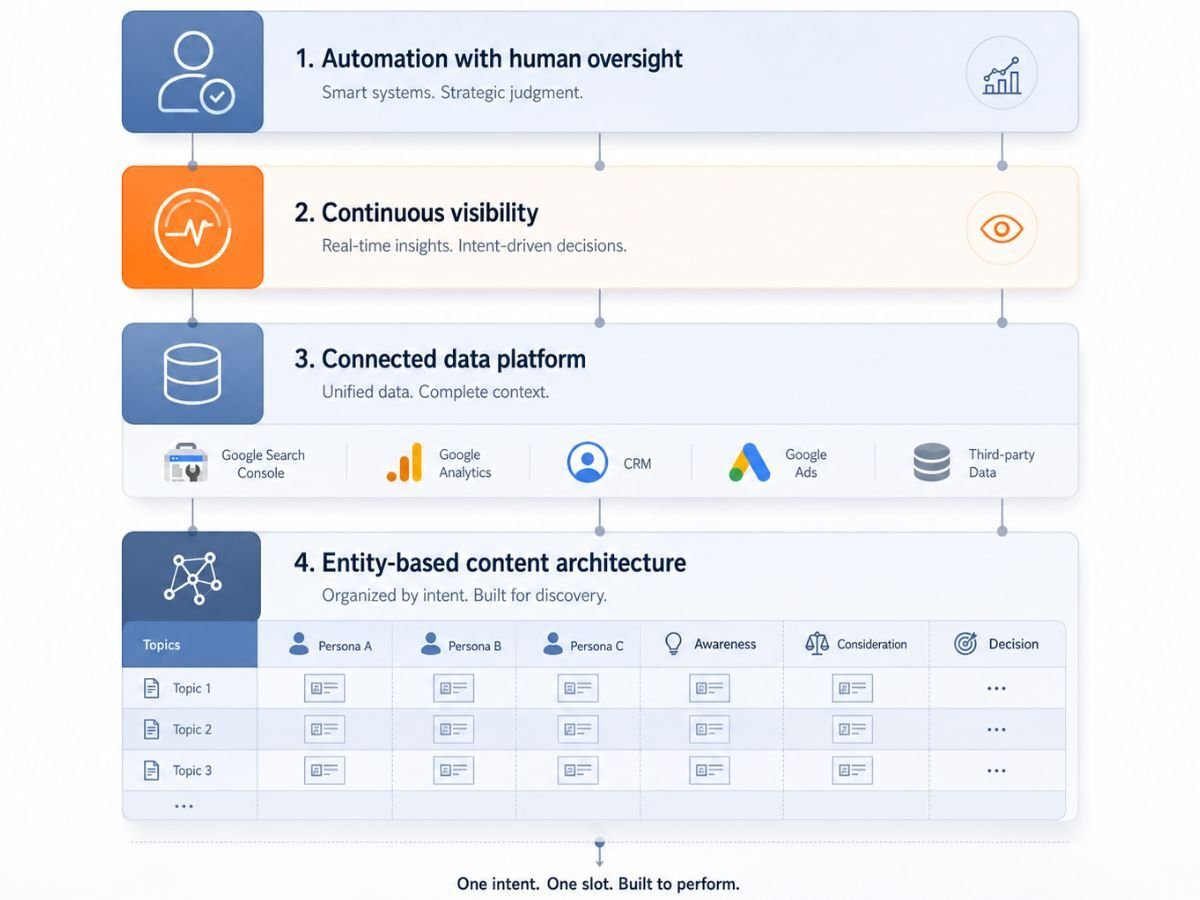
At PureSEM, we approach this as an engineering problem. What we build is the right content in the right architecture, backed by data that connects every page to every query, every persona, every funnel stage, and every conversion outcome.

PureSEM Blog Image

What that looks like in practice:

An entity-based content architecture, not a topic list. Every concept your ICP cares about is mapped to subtopics. Subtopics get crossed with personas, persona struggles, and funnel stages. The result is a matrix where every page has exactly one intent slot it owns. Cannibalization can't happen by accident because no two pages are ever assigned the same slot.

A platform connected to your full data ecosystem. Google Search Console, Google Analytics, Google Ads, your CRM, your inbound link data, and rank tracking all live in one place. The system sees in real time which pages target which queries, where overlap is starting to drift, and which queries competitors are capturing.

Visibility across the entire site, continuously. Homepage, product pages, solutions pages, pillar guides, and conversion pages are all tracked against the same matrix. Every page gets reviewed for strategic fit, internal link integrity, and intent alignment. Issues surface before they become pipeline problems.

Automation with human oversight at every layer. The matrix produces an almost infinite number of legitimate content angles, but every published piece passes a human editor. The speed comes from the system. The quality comes from the people.

When a client asks whether building pillar pages will cannibalize their product pages, we can show them in real time exactly which intent slots their existing pages own, where the gaps are, and how each new piece fits into a matrix that makes overlap structurally impossible. No "trust us" required.

That is the difference between hoping the strategy holds and engineering it so it has to.

If you want to see where your company currently shows up in AI search, we run free AI Search Visibility Assessments for qualifying B2B companies. We will send you a custom analysis and recommendations within a few days.


References

  1. John Mueller, Google Search Central office hours, August 2022. Transcript and analysis at https://iloveseo.com/seo/john-mueller-says-keyword-cannibalization-will-dilute-the-ranking-strength-of-your-pages/

  2. Mateusz Makosiewicz, "Keyword Diversification: Cannibalization's Good Twin," Ahrefs blog. https://ahrefs.com/blog/multiple-rankings-study/

  3. Ahrefs, "AI Overviews Reduce Clicks by 58%" (December 2025 update of original April 2025 study of 300,000 keywords). https://ahrefs.com/blog/ai-overviews-reduce-clicks-update/

  4. Pew Research Center, "Google users are less likely to click on links when an AI summary appears in the results," July 22, 2025. https://www.pewresearch.org/short-reads/2025/07/22/google-users-are-less-likely-to-click-on-links-when-an-ai-summary-appears-in-the-results/

  5. Seer Interactive, "AIO Impact on Google CTR: 2026 Update," April 2026. Analysis of 53 brands, 5.47 million tracked queries, and 2.43 billion organic impressions across January 2025 to February 2026. https://www.seerinteractive.com/insights/aio-impact-on-google-ctr-2026-update

  6. Gartner, "The B2B Buying Journey" research series. https://www.gartner.com/en/sales/insights/b2b-buying-journey

Your keyword universe is a business asset, why not treat it like one?

Your keyword universe is a business asset, why not treat it like one?

Have you ever wondered how much time is wasted across your team and agencies researching, compiling, and analyzing the same keyword data in different...

Read More
What Are the Top Channels for Inbound Lead Generation?

What Are the Top Channels for Inbound Lead Generation?

You’re likely here because you’re responsible for generating B2B leads and sales pipelines, and you’re likely trying to decide which marketing...

Read More
The AI-Enabled Buyer

The AI-Enabled Buyer

Yesterday, Dave Shanley of ContentCamel.io and I ran a webinar: The AI-enabled buyer.

Read More